Golden and Noble Works


“A wife too should regard her duties in the same light, as she suckles the child, rocks and bathes it, and cares for it in other ways; and as she busies herself with other duties and renders help and obedience to her husband. These are truly golden and noble works."
Martin Luther

Wednesday, April 20, 2011

The Seven Last Words of Christ - I

Kristi L. thought it would be good to reflect on the Seven Last Words of Christ during these last days of Holy Week. Our first installment are the first three words Christ spoke from the cross.

Courtesy The Church of the Lutheran Confession
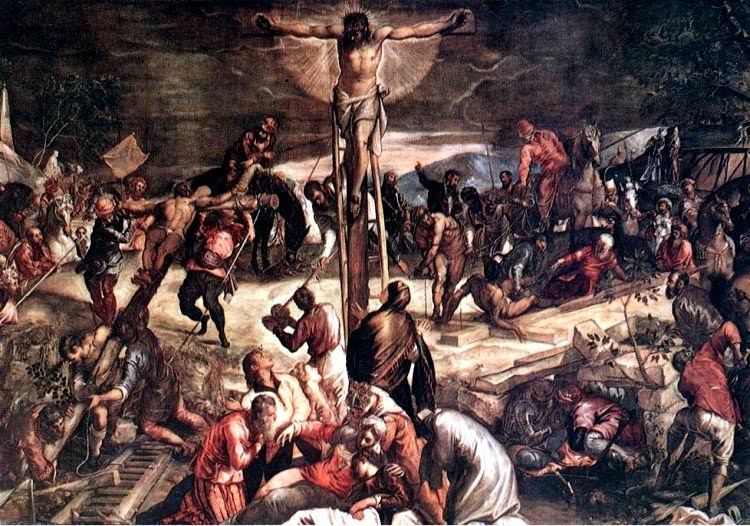

THE FIRST WORD FROM THE CROSS

“Father, forgive them, for they know not what they do” (Luke 23:34).

Throughout His trial Jesus did not complain. He did not strike back with His tongue at the evil that was hurled at Him. He was silent, except when it was necessary to witness to the truth or proclaim the honor of God. Yet upon the cross, when the die was cast He spoke treasured words. The first words were words of intercession. But for whom were they spoken? They were spoken for the betrayer and the denier. They were spoken for the soldiers who had taken Him in the garden as well as for those who had borne false witness against Him. They were spoken for the High Priest and the crowd that called for His crucifixion. Included were Pilate and Herod, and finally those who crucified Him and mocked Him at the cross.

Even as He prayed He witnessed to His relationship to God. He called Him, “Father.” He did not say to the people at the cross, “I forgive you.” The offenses against Him were directed at the Father who had sent Him. He implored the Father to forgive them, and thus showed that He had not come into the world to condemn the world, but that the world through Him might be saved.

The cross of torment and death was the cross of love. We sing in a hymn, “The King of love my Shepherd is.” Never was such love shown by one person for so many as when the Savior God, having taken the sins of mankind on Himself, died to validate the very prayer that He spoke, “Father, forgive them, for they know not what they do.”

But this all sounds so abstract to many. Furthermore, of what importance are the words spoken by Jesus Christ two millennia ago? Today the issues are race relations, the economy, the impending war, taxes, social welfare and equality and a myriad of other things. Who cares about what Christ said so long ago?

In response let us recognize that those words were spoken for us and for all people. When the crowd cried “crucify Him” Jesus” response was “Forgive them, Father.” In the face of the world’s blasphemy, Jesus says, “Forgive them.” When our conscience cries out against us because we have transgressed, Jesus” words still echo across the centuries, “Father forgive them.” The message of the Gospel is that where there is forgiveness of sins there is also life and salvation. All who recognize the terrible burden of sin and its eternal consequence are thankful for the price Jesus paid for which reason the Father graciously forgives our sin.


THE SECOND WORD FROM THE CROSS:

“Verily I say unto thee, Today shalt thou be with me in paradise” (Luke 23:43).

“And when they were come to the place, which is called Calvary, there they crucified him, and the malefactors, one on the right hand, and the other on the left” (Luke 23:33). Around the cross were representatives of all kinds of people. Thee were the proud, the self-righteous, the scoffers and mockers. There were people sympathetic to Jesus. They were all there by choice. And then there were some who were not there by choice. They were two others suffering the same punishment as Jesus, though for different reason. They were malefactors who were not there by choice, but whose life choices put them in this circumstance. The one criminal mocked Jesus from the cross. He died with cursing on his lips. What a horrible way to die! But there was the other who was won by the power of the cross. He had heard the first word of Jesus in which Jesus implored the Father to forgive his crucifiers. “And he said unto Jesus, Lord, remember me when thou comest into thy kingdom” (Luke 23: 42). We often speak cynically about condemned criminals who repent on death row. No doubt there are some who do confess the Lord without meaning it when they are confronted with death, in other words they do it for effect. But we should be careful about such judgment.

The criminal who was facing death hanging alongside Jesus spoke from the heart. He confessed his sin and unworthiness. Luther* said, “In the Garden He (Jesus) was comforted by an angel, on the cross by a murderer hanging beside Him. How strange that God should let His Son be comforted by a murderer.” There is joy in heaven over one sinner that repents.

Jesus’ response is a comfort to us. This man did not plead his works or any righteousness of his own. How could he? He had wasted away his life in crime and was now receiving the just reward of his deeds. “The wages of sin is death” (Romans 6: 23). If ever there was a strong commentary on the fact that salvation is by grace through faith without the deeds of the Law here is one. The gift of salvation is not earned. It is given. Jesus said to the penitent thief, “Verily I say unto thee, Today shalt thou be with me in paradise.” The Lord had said, “And I, if I be lifted up from the earth, will draw all men unto me” (John 12:32). Through Jesus’ word to this man, He declared the penitent thief to be one who was drawn to Him.

What a way to die! “Today you will be with me in paradise.” Analyze those words. Today with Jesus. in paradise. How blessed is the death of the saints; how great the breadth and depth of the grace of God! Let us not wonder how this evil man could be shown such grace. But let us thank God that grace is so rich to even include him, for then it will include us whose sins against the Lord are every bit as dark, even if not as spectacular. One church father* wrote, “I do not ask for the measure of Paul’s grace. I ask not for Peter’s portion; but I fervently beg to receive what Thou on the cross didst bestow on the malefactor.” On our last day how blessed we will be as we cling to the cross of Jesus from which will come to us these gracious words, “Verily I say unto thee, Today shalt thou be with me in paradise.” *Quoted in “The Passion Story”- Wilhelm Besser


THE THIRD WORD FROM THE CROSS

“When Jesus therefore saw his mother, and the disciple standing by, whom he loved, he saith unto his mother, Woman, behold thy son! Then saith he to the disciple, Behold thy mother! And from that hour that disciple took her unto his own home” (John 19:26-27).

As Jesus hung upon the cross there were many who hung around the cross. Besides His friends of whom there were fewer, there were the mockers and scoffers. The sight of Jesus hanging upon the cross, as well as the sound of evil voices mocking her Son surely brought to Mary’s mind the prophecy of Simeon. Simeon had said to Mary, “ And Simeon blessed them, and said unto Mary his mother, Behold, this child is set for the fall and rising again of many in Israel; and for a sign which shall be spoken against; (Yea, a sword shall pierce through thy own soul also,) that the thoughts of many hearts may be revealed” (Luke 2:34-35). The name “Mary” means, “bitter.” Here at the cross she tasted the bitterness of the helplessness of a mother who could neither take the place of Her Son nor alleviate His suffering.

But greater than the mother-love of Mary is the love of her Son, whom she also knew as her Savior. For she had said in the Magnificat “My spirit hath rejoiced in God my Savior” (Luke 2:47). Neither she nor we have ever been called upon to exercise sacrificial love to the extent Jesus did. Yet in the midst of His suffering there is exhibited what the Scriptures record, “Having loved His own which were in the world, He loved them unto the end” (John 13:1). In His last hours, He did not forget His mother but provided a protector for her. The Savior provided her with another “son.” He saith unto his mother, “Woman, behold thy son!” Jesus called her “woman” and not “mother” because He would have her think of Him in relation to her atonement by Him rather than in a narrower familial relationship. Mary could lean on John as a son. But the concern was to be mutual. John too, as the disciple “ whom Jesus loved” was also in need of support. “Then saith He to the disciple (John), Behold thy mother! And from that hour that disciple took her unto his own home.”

In these words, first of all, we learn that our welfare is the constant and abiding concern of our Savior. He knows our pain and sorrow, even in His own. He did not die on the cross in our place to forgive us our sin and win heaven for us only then to forget us while we are waiting for the eternal dawn. Here He also helps us to appreciate that He helps and strengthens, and encourages us through one another. We do not live on an island. At the cross we learn to appreciate the mutual love and care that exists within a fellowship, as well as the responsibility that members of the body of Christ are to have for one another. If in His deepest suffering He loved His own so much that He would provide for their mutual welfare, how also ought we to care for and love one another, and thus reflect Jesus’ love whereby He has loved us all!

Image 1
Image 2
Image 3

Saturday, April 16, 2011

Things We Can Learn from a Dog - From Jenny S.


Meet Cody

Jenny writes:

A blogger I visit frequently, the Bearded Iris, posted this and it brought tears to my eyes...and down my cheeks. If you own, or have owned, a dog you must read this list. Touching, really. Makes me want to go cuddle Cody, our lab/boxer mix.

(I'll warn you about Iris though...although her blog is true-to-life and funny, it's also somewhat colorful (PG-13) in Iris's unique way. It may not be for everyone.)

Things We Can Learn from a Dog

1. Never pass up the opportunity to go for a joy ride.


2. Allow the experience of fresh air and the wind in your face to be pure ecstasy.

3. When loved ones come home, always run to greet them.

4. When it’s in your best interest, always practice obedience.

5. Let others know when they’ve invaded your territory.

6. Take naps and always stretch before rising.

7. Run, romp, and play daily.

8. Eat with gusto and enthusiasm.

9. Be loyal.

10. Never pretend to be something you’re not.

11. If what you want lies buried, dig until you find it.

12. When someone is having a bad day, be silent, sit close by, and nuzzle them gently.

13. Delight in the simple joy of a long walk.

14. Thrive on attention and let people touch you.

15. Avoid biting when a simple growl will do.

16. On hot days, drink lots of water and lie under a shady tree.

17. When you are happy, dance around and wag your entire body.

18. No matter how often you are criticized, don’t buy into the guilt thing and pout. Run right back and make friends.


Thursday, April 14, 2011

More Ideas for Holy Week and Easter

Sorry, I couldn't help myself!

I'm an "idea hoarder". I like collecting good ideas for using or saving for future use. With all the good ways to celebrate Easter flying around here I thought I'd share some others that I've come across.

Just so you know, many of my sources are Roman Catholic but with some discretion I still find them useful.

Holy Week
Stations of The Cross coloring pages
Lenten or Good Friday Cross made of sticks, very easy!
Good Friday Hot Cross Buns recipe
More ideas for Holy Week here

Palm Sunday
Make Palm Crosses
Make a Palm Branch craft for children
More fun ideas for Palm Sunday here

Easter
Eggs:
"Jesus Eggs"
Resurrection Eggs

Eating:
Empty Tomb Rolls
More food here

Decorating:
Easter Tree (reading Scripture verses, start this 2 weeks before Easter)
Alleluia Tree
Alleluia Banner (nice idea to have "buried" it during Lent then bring it out for display at Easter)

Do any of you continue celebrating Easter throughout the entire 50 days of the Easter Season? If so, what do you do?

Monday, April 11, 2011

The History of Aprons


From Kristi L.

I don't think our kids know what an apron is. The principal use of Grandma's apron was to protect the dress underneath, because she only had a few, it was easier to wash aprons than dresses and they used less material, but along with that, it served as a potholder for removing hot pans from the oven. It was wonderful for drying children's tears, and on occasion was even used for cleaning out dirty ears.

From the chicken coop, the apron was used for carrying eggs, fussy chicks, and sometimes half-hatched eggs to be finished in the warming oven. When company came, those aprons were ideal hiding places for shy kids. And when the weather was cold, grandma wrapped it around her arms. Those big old aprons wiped many a perspiring brow, bent over the hot wood stove. Chips and kindling wood were brought into the kitchen in that apron.

From the garden, it carried all sorts of vegetables. After the peas had been shelled, it carried out the hulls.
In the fall, the apron was used to bring in apples that had fallen from the trees.

When unexpected company drove up the road, it was surprising how much furniture that old apron could dust in a matter of seconds.
When dinner was ready, Grandma walked out onto the porch, waved her apron, and the men knew it was time to come in from the fields to dinner.

It will be a long time before someone invents something that will replace that 'old-time apron' that served so many purposes.


Send this to those who would know, and love, the story about Grandma's aprons. Or it can be a good history lesson for those that have no idea how the apron played a part in our lives.

REMEMBER:
Grandma used to set her hot baked apple pies on the window sill to cool. Her granddaughters set theirs on the window sill to thaw.
They would go crazy now trying to figure out how many germs were on that apron..
I don't think I ever caught anything from an apron ..... but Love !!


That was a poem that was shared at the luncheon I attended on Saturday. The speaker gave a humorous presentation regarding her grandmother’s apron drawer. There are so many different aprons out there, both from the past and present.

I own my grandmother’s apron. It’s made of red cotton with blue-and white colored flowers on it. Very much the old patterns of fabric. There’s blue rickrack sewn all over the place to “dress it up.” It has two shoulder straps that button in the middle of the back and a tie around the back as well. And, of course, two pockets. I like to wear it because it reminds me of my grandma. I use it mainly when I’m canning and working with garden produce in the summer. Other than that, I don’t really wear it too much. I probably should, for as much flour as my shirt ends up wearing when I’m baking. I really do like aprons and should wear them more often, simply to keep me clean. Plus, it gives our members something to chuckle over when they see me wearing it. I do have a new apron, but have I used it? No. Don’t ask me why. It’s just sitting there, begging to get dirty.

Joanna has an apron, too. It’s one of my grandma’s smaller ones. She used to wrap it all the way around her back and tie it at the front. Alas, she has grown, so now she ties it at the back. She knows that canning requires an apron, and she runs to the drawer to get hers and mine. That’s a memory in the making.

How about you? Do you wear an apron?

Thursday, April 7, 2011

Easter Approaches!


Holy Week and Easter are coming up and I have been thinking about different ways to commemorate and celebrate this time with my family.

For Palm Sunday I wanted to try making small crosses out of palm branches that my girls could wear to church. I think little things like this are good for teaching children. But I don't have a lot planned for the rest of Holy Week other than making Hot Cross Buns for Good Friday and going to our evening services.

I've thought about Maundy Thursday being a day to show love for others. I read on the LCMS website that one custom was to carry gifts to the poor in baskets on that day. With that in mind I could come up with several things we could do on this day in our community or for members in our church.

For Easter Sunday in our home, our Lenten countdown crown of thorns "calendar" (sorry, I can't think of what else to call it) will be donned with white flowers and purple will be replaced with white to visually mark the change in season. I will have Easter baskets for my children (no, the Easter Bunny doesn't come to our house, just his baskets full of treats!) and a special meal prepared, but do any of you find that this particular Sunday is exhausting? Especially for your pastor husband? I always look forward to it and dread it a little to be honest. Probably because I'm married to an introvert who just wants to *nap after church AND I have tiny kiddos that tend to make the simplest events much more difficult than I'd thought! But even so, I want to do something special on this festive day.

So, what does your family do during Holy Week and Easter? I'd love to hear about your traditions!

*My husband has three service on Easter morning, 6:30, 9 and 10:30....he deserves a nap!

Tuesday, April 5, 2011

Kristi: What I'm Reading


Harold Senkbeil’s book Dying to Live

All of our discussion on prayer and the amount of prayer and how to pray has prompted me to re-read Senkbeil’s section on private prayer. Allow me to share several excerpts from the book...

With Heart and Mouth – These are the two focal points of prayer. We would do well to keep our mouths linked with our hearts when we pray; private prayer works best when it is oral prayer... While the silent meditation of our heart is just as pleasing to God as the words of our mouth, we would do well to seek out places for private prayer where we can speak out loud... We’re not pure spirits, after all; God has given us bodies as well as souls. And so when we as the children of God come to our Father in heaven it’s natural that we form our words with our lips as well as our hearts... Not only is it the most natural way for us to say what’s on our heart, but it is also the natural way for our hearts to listen to the Word of God.

I prayed aloud as a child as my parents taught me the words and rhythm of prayer. Somewhere along the way I abandoned that practice and became a silent pray-er. Why? I have no idea. Singing the word of God is one way to hear the Word of God, as well as pray it.

Dr. Senkbeil writes these words regarding song. When we’re alone at prayer singing reminds us that we are not really alone. The unseen fellowship of the entire church is with us in that prayer; we hear it in the church’s song placed on our lips to sing. In either public or private, singing adds a third dimension to prayer. The mouth and the heart are involved in all prayer. But in singing, the whole body gets to join in; the prayers and praises originating from the heart reverberate through muscle, bone, and cartilage.

What should I use to help form my prayer life? I’ve seen some wonderful suggestions from our ladies. Which one to choose?

Hear Dr. Senkbeil once more. This is where prayer books come in handy. They provide a framework for prayer that can see us through the thick and thin of our spiritual lives. The idea of using a prayer book might seem artificial at first but there’s a lot of wisdom in it. No one would seriously think about taking a trip through unknown territory without consulting a map. Why shouldn’t we consult a spiritual guide when we set out to pray? Please don’t be concerned that the use of “set prayers” will stifle the prayers of your heart. Properly used, you’ll find that prayer books actually prompt the heart to greater depth of prayer.

Anyone who wants to get in shape physically gets set for a regimen. Physical conditioning demands discipline; muscles must be exercised in order to gain tone and strength. But muscles don’t exercise themselves; bodies would rather sit than get up to run or life weights. You know the old saying: “No pain, no gain.” Why should it be any different with our spirits than with our bodies?


He goes on to suggest the Prayer Office. He also reminds the reader that Jesus is ALWAYS praying for us. That is probably my greatest comfort as I struggle with prayer.

Ladies, you encourage me. Just yesterday I began my spring training regimen for my own physical health. I did some exercising. Perhaps this is a good time for me to also work on my spiritual health.

Friday, April 1, 2011

More on Prayer


*In continuing our discussion on prayer I had this to add. Long post alert, sorry!

As a Christian I want to pray more. And we know, as Christians we are commanded to pray. It isn't optional. But I find myself thinking that way about it. Here is what Luther says about prayer.
"Prayer is therefore as strictly and earnestly commanded as all other commandments: to have no other God, not to kill, not to steal, etc."

"there stands the commandment, Thou shalt and must do it, so also here it is not left to my will to do it or leave it undone, but prayer shall and must be offered at the risk of God's wrath and displeasure."

"This is therefore to be understood and noted before everything else, in order that thereby we may silence and repel the thoughts which would keep and deter us from praying, as though it were not of much consequence if we do not pray, or as though it were commanded those who are holier and in better favor with God than we; as, indeed, the human heart is by nature so despondent that it always flees from God and imagines that He does not wish or desire our prayer, because we are sinners and have merited nothing but wrath."

"In the second place, we should be the more urged and incited to pray because God has also added a promise, and declared that it shall surely be done to us as we pray, as He says, Call upon Me in the day of trouble: I will deliver thee. Ps. 51:15 And Christ in the Gospel of St.Matthew Ask, and it shall be given you. For every one that asketh receiveth. Matt. 7:7 Such promises ought certainly to encourage and kindle our hearts to pray with pleasure and delight, since He testifies with His [own] word that our prayer is heartily pleasing to Him, moreover, that it shall assuredly be heard and granted, in order that we may not despise it or think lightly of it, and pray at a venture."
Since having babies I have fallen into the habit of not making prayer a daily habit, so this is not easy stuff for me to hear. But what my flesh needs to hear. The flesh that must drown and die daily. So what do I pray? How do I pray?

Luther says in the Large Catechism,
"there is no nobler prayer to be found upon earth than the Lord's Prayer which we daily pray."
This is the prayer I say most when I can't find words or when I'm exhausted and at my wits end. It is the prayer that God loves to hear and, Luther again,
"which we ought not to surrender for all the riches of the world."
Use the prayer our Lord taught us!

In addition to the Lord's Prayer, I wanted to share a wonderful resource that I have begun to use. It's called Starck's Prayer-Book. I highly recommend getting this book (in the original 1921 English translation I'll add). The author, who lived during the 17th & 18th centuries, has the most beautiful and seamless way of weaving Holy Scripture into these prayers giving them a richness that other prayer books I've used have lacked. It provides prayers for each day of the week, morning and evening, along with a short exhortation for that day and a hymn. The book goes on to include:

Prayers for the Festival Seasons
Prayers for Spiritual and Bodily Blessings
Prayers for the Afflicted, the Sick, the Dying and for Special Occasions (Birthdays, War Time, Weather and Travel etc.)

I know prayer books aren't everyone's "thing", and at one point in my life I believed that the prayer that wasn't from your heart (prayers that were written by others) wasn't real prayer.

But I have come to learn how very helpful these written prayers can be, especially during times I just don't know what to pray or how to pray, or worse don't even want to pray.

The link I've provided to find the book is to Emmanuel Press. A printing business that is putting out some great resources. Poke around the site and take a look. Also, note that they have published a book of prayers for mothers; Starck's Motherhood Prayers for All Occasions (which is found as an appendix in Starck's Prayer-Book) as a separate volume.

While there is a prayer of parents for their children in this book, most of these prayers are for those expecting a child or who have recently delivered a child and they're wonderful. Not all of you are in this situation of course, but I have been told by several mothers not in either of these stages of life that the prayers are useful to them as well.

So, do you use aids when you pray? What do you use? A book? A list? A journal?